Insights
•
What Is SEO and How Does It Work?
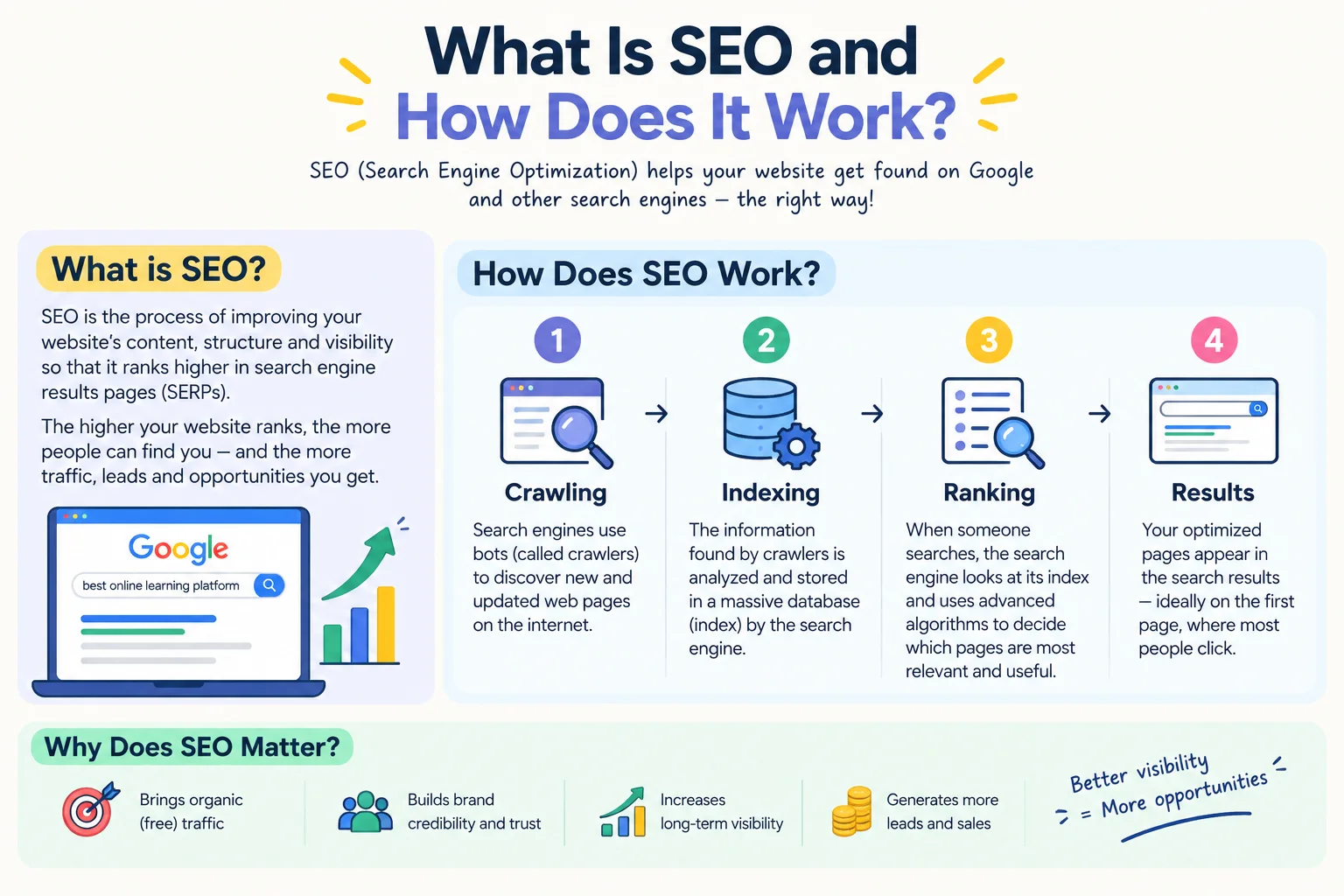
If you have a website, getting people to find it online is just as important as having a great product or service. This is where SEO (Search Engine Optimization) comes in.
SEO is the process of improving a website so that it can appear more prominently in search engine results when people search for relevant products, services, or information.
But how does SEO actually work? And why is it important for businesses?
Let's break it down.
What Is SEO?
SEO stands for Search Engine Optimization.
It involves optimizing your website, content, and online presence to help search engines understand your website and determine when it should appear in search results.
For example, if you own a digital marketing agency and someone searches for:
"digital marketing agency near me"
SEO can help your website appear among the relevant search results.
Unlike paid advertising, where businesses pay to display ads, SEO focuses primarily on earning organic (unpaid) traffic from search engines.
How Does SEO Work?
Search engines such as Google use automated systems to discover, understand, and rank web pages.
Although search algorithms are complex and constantly changing, SEO generally works through three important stages:
1. Crawling
Search engines use automated programs, often called crawlers or bots, to discover pages across the internet.
These crawlers follow links between pages and collect information about websites and their content.
If a search engine can properly access your website, it has a better opportunity to discover and understand your pages.
2. Indexing
After discovering a page, the search engine analyzes and stores information about it in its index.
The index is essentially a massive database of web pages and information that search engines can use when responding to searches.
If a page isn't properly indexed, it may not appear in search results.
3. Ranking
When someone enters a search query, the search engine analyzes its index and determines which pages are most relevant to that query.
Many factors can influence rankings, including:
Relevance of the content
Quality and usefulness of the information
Website experience
Page speed
Mobile usability
Links from other websites
Search intent
Website structure and accessibility
The goal of SEO is to make your website easier for search engines to understand while providing a useful experience for visitors.
The Main Types of SEO
SEO isn't just about adding keywords to a website. It involves several different areas.
On-Page SEO
On-page SEO focuses on elements you can optimize directly on your website.
This includes:
Page titles
Meta descriptions
Headings
Keywords
Website content
Internal links
Image optimization
URLs
Search intent
For example, instead of creating a generic page titled "Services," a digital marketing agency might create a well-structured page focused on "Digital Marketing Services for Small Businesses."
Technical SEO
Technical SEO focuses on the technical aspects of your website that help search engines crawl and understand it.
Important areas include:
Website speed
Mobile responsiveness
XML sitemaps
HTTPS security
Website architecture
Crawlability
Indexability
Structured data
Broken links
A technically sound website makes it easier for search engines to access and interpret your content.
Off-Page SEO
Off-page SEO involves activities that happen outside your website but can influence your site's visibility and authority.
One major area is link building.
When reputable websites link to your content, those links can help search engines discover your pages and may contribute to how your website's authority is evaluated.
Other off-page activities can include digital PR, brand mentions, and relevant business listings.
Local SEO
If your business serves customers in a specific geographic area, local SEO can be particularly important.
Local SEO helps businesses become more visible for searches related to a location.
For example:
"SEO agency in Delhi"
"digital marketing company near me"
"best marketing agency in Delhi"
Local SEO can involve optimizing your Google Business Profile, maintaining accurate business information, collecting genuine customer reviews, and creating location-relevant content.
Why Is SEO Important for Businesses?
A strong SEO strategy can help businesses attract people who are actively searching for their products, services, or information.
Some potential benefits include:
Increased Organic Traffic
Higher visibility for relevant searches can bring more visitors to your website without paying for every individual click.
Better Brand Visibility
Appearing consistently in relevant search results can increase awareness of your business.
More Qualified Leads
People who find your website while searching for a specific solution may already have an interest in what you offer.
Long-Term Growth
Unlike a paid campaign that stops generating traffic when the budget is paused, well-optimized content can continue attracting organic visitors over time.
However, SEO is not an instant marketing solution. Results can take time and depend on factors such as competition, website quality, industry, content, and the effectiveness of the SEO strategy.
SEO vs. Paid Advertising
SEO and paid advertising can both help businesses generate website traffic, but they work differently.
SEO Paid Advertising
Focuses on organic visibility Focuses on paid placements
Can take time to produce results Can generate traffic quickly
Requires ongoing optimization Requires ongoing advertising budget
Traffic isn't purchased per click Advertisers typically pay for clicks or impressions
Can build long-term search visibility Campaign visibility generally depends on active spending
Many businesses use both SEO and paid advertising as part of a broader digital marketing strategy.
How to Get Started With SEO
If you're new to SEO, start with the fundamentals:
Understand your target audience — Identify what your potential customers are searching for.
Research relevant keywords — Find topics and search terms related to your products or services.
Create useful content — Answer your audience's questions clearly and thoroughly.
Optimize your website — Improve titles, headings, URLs, internal links, images, and other on-page elements.
Improve technical SEO — Make sure search engines can crawl and index your website effectively.
Build credibility — Earn relevant, high-quality links and mentions from reputable sources.
Focus on user experience — Make your website fast, accessible, mobile-friendly, and easy to navigate.
Monitor performance — Use analytics and search performance data to understand what's working and where improvements are needed.
Common SEO Mistakes to Avoid
Some businesses make the mistake of treating SEO as simply adding keywords to pages.
Avoid practices such as:
Keyword stuffing
Publishing low-quality content at scale
Buying low-quality backlinks
Copying content from other websites
Ignoring mobile users
Neglecting technical SEO
Creating content without understanding search intent
Expecting immediate results
Modern SEO is much more focused on relevance, quality, usability, and satisfying the user's search intent.
How Long Does SEO Take to Work?
There is no universal timeline for SEO.
A new website in a competitive industry may take considerable time to establish visibility, while an established website with strong authority may see improvements sooner.
Your results can depend on:
Your current website condition
Competition
Industry
Keyword difficulty
Content quality
Technical SEO
Website authority
Link profile
Consistency of optimization
The important thing is to treat SEO as an ongoing process rather than a one-time project.
Final Thoughts
SEO is the process of making your website easier for search engines to discover, understand, and rank while providing valuable information and a good experience for visitors.
From keyword research and content creation to technical optimization, local SEO, and link building, successful SEO combines multiple activities.
For businesses looking to build sustainable online visibility, SEO can be an important part of a broader digital marketing strategy.
The key is to focus less on trying to "trick" search engines and more on creating a website that genuinely helps the people searching for your products, services, and information.
Frequently Asked Questions
Is SEO free?
Organic SEO does not require businesses to pay search engines for each click. However, SEO usually requires investment in content, tools, technical improvements, strategy, or professional services.
Can I do SEO myself?
Yes. Businesses can handle basic SEO themselves by learning keyword research, content optimization, technical fundamentals, and analytics. More competitive websites may benefit from experienced SEO professionals.
Is SEO better than Google Ads?
SEO and Google Ads serve different purposes. SEO focuses on organic search visibility, while Google Ads provides paid search placements. The appropriate approach depends on your goals, budget, competition, and timeline.
Does SEO still work in 2026?
Yes. Search remains an important way for people to discover information, businesses, products, and services. However, SEO continues to evolve as search engines, user behavior, and AI-powered search experiences change.
Want to scale your business organic traffic?
Let WebBrandBuilders optimize your search appearance & design strategies.